 Add to Chrome
 Add to Firefox
 Add to Edge
Principled Federated Random Forests for Heterogeneous Data
Feb 03, 2026
Random Forests (RF) are among the most powerful and widely used predictive models for centralized tabular data, yet few methods exist to adapt them to the federated learning setting. Unlike most federated learning approaches, the piecewise-constant nature of RF prevents exact gradient-based optimization. As a result, existing federated RF implementations rely on unprincipled heuristics: for instance, aggregating decision trees trained independently on clients fails to optimize the global impurity criterion, even under simple distribution shifts. We propose FedForest, a new federated RF algorithm for horizontally partitioned data that naturally accommodates diverse forms of client data heterogeneity, from covariate shift to more complex outcome shift mechanisms. We prove that our splitting procedure, based on aggregating carefully chosen client statistics, closely approximates the split selected by a centralized algorithm. Moreover, FedForest allows splits on client indicators, enabling a non-parametric form of personalization that is absent from prior federated random forest methods. Empirically, we demonstrate that the resulting federated forests closely match centralized performance across heterogeneous benchmarks while remaining communication-efficient.

Privacy Amplification Persists under Unlimited Synthetic Data Release
Feb 03, 2026We study privacy amplification by synthetic data release, a phenomenon in which differential privacy guarantees are improved by releasing only synthetic data rather than the private generative model itself. Recent work by Pierquin et al. (2025) established the first formal amplification guarantees for a linear generator, but they apply only in asymptotic regimes where the model dimension far exceeds the number of released synthetic records, limiting their practical relevance. In this work, we show a surprising result: under a bounded-parameter assumption, privacy amplification persists even when releasing an unbounded number of synthetic records, thereby improving upon the bounds of Pierquin et al. (2025). Our analysis provides structural insights that may guide the development of tighter privacy guarantees for more complex release mechanisms.
Membership Inference Attacks from Causal Principles
Feb 02, 2026Membership Inference Attacks (MIAs) are widely used to quantify training data memorization and assess privacy risks. Standard evaluation requires repeated retraining, which is computationally costly for large models. One-run methods (single training with randomized data inclusion) and zero-run methods (post hoc evaluation) are often used instead, though their statistical validity remains unclear. To address this gap, we frame MIA evaluation as a causal inference problem, defining memorization as the causal effect of including a data point in the training set. This novel formulation reveals and formalizes key sources of bias in existing protocols: one-run methods suffer from interference between jointly included points, while zero-run evaluations popular for LLMs are confounded by non-random membership assignment. We derive causal analogues of standard MIA metrics and propose practical estimators for multi-run, one-run, and zero-run regimes with non-asymptotic consistency guarantees. Experiments on real-world data show that our approach enables reliable memorization measurement even when retraining is impractical and under distribution shift, providing a principled foundation for privacy evaluation in modern AI systems.
Optimal Transport under Group Fairness Constraints
Jan 12, 2026Ensuring fairness in matching algorithms is a key challenge in allocating scarce resources and positions. Focusing on Optimal Transport (OT), we introduce a novel notion of group fairness requiring that the probability of matching two individuals from any two given groups in the OT plan satisfies a predefined target. We first propose \texttt{FairSinkhorn}, a modified Sinkhorn algorithm to compute perfectly fair transport plans efficiently. Since exact fairness can significantly degrade matching quality in practice, we then develop two relaxation strategies. The first one involves solving a penalised OT problem, for which we derive novel finite-sample complexity guarantees. This result is of independent interest as it can be generalized to arbitrary convex penalties. Our second strategy leverages bilevel optimization to learn a ground cost that induces a fair OT solution, and we establish a bound guaranteeing that the learned cost yields fair matchings on unseen data. Finally, we present empirical results that illustrate the trade-offs between fairness and performance.
Federated Learning for MRI-based BrainAGE: a multicenter study on post-stroke functional outcome prediction
Jun 18, 2025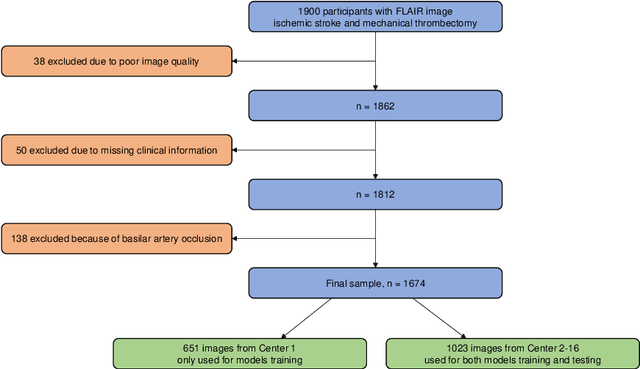
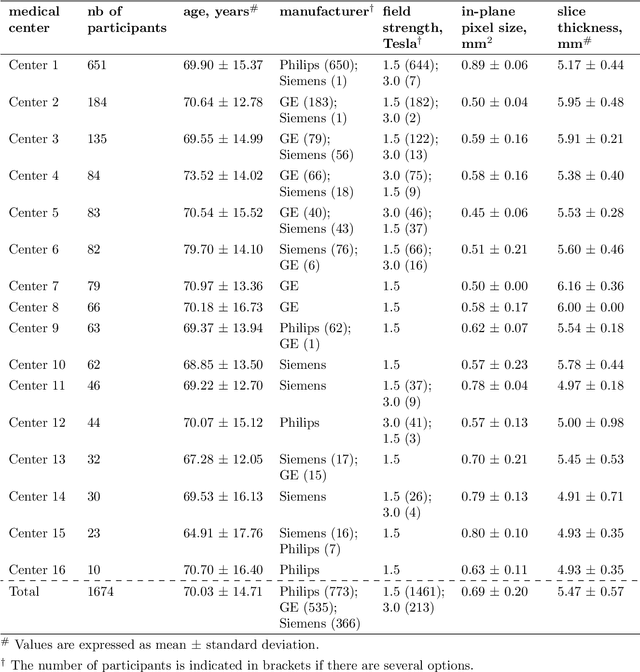
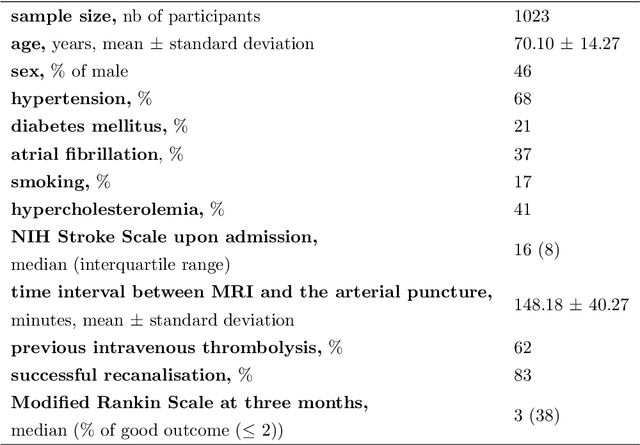
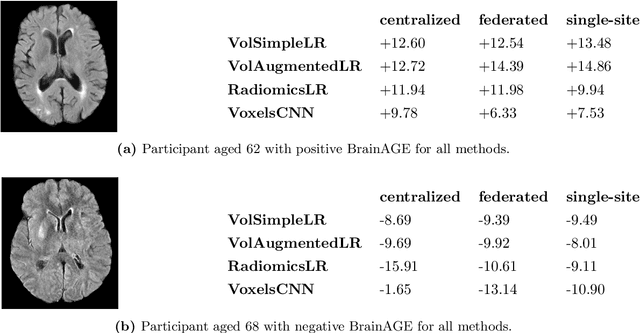
$\textbf{Objective:}$ Brain-predicted age difference (BrainAGE) is a neuroimaging biomarker reflecting brain health. However, training robust BrainAGE models requires large datasets, often restricted by privacy concerns. This study evaluates the performance of federated learning (FL) for BrainAGE estimation in ischemic stroke patients treated with mechanical thrombectomy, and investigates its association with clinical phenotypes and functional outcomes. $\textbf{Methods:}$ We used FLAIR brain images from 1674 stroke patients across 16 hospital centers. We implemented standard machine learning and deep learning models for BrainAGE estimates under three data management strategies: centralized learning (pooled data), FL (local training at each site), and single-site learning. We reported prediction errors and examined associations between BrainAGE and vascular risk factors (e.g., diabetes mellitus, hypertension, smoking), as well as functional outcomes at three months post-stroke. Logistic regression evaluated BrainAGE's predictive value for these outcomes, adjusting for age, sex, vascular risk factors, stroke severity, time between MRI and arterial puncture, prior intravenous thrombolysis, and recanalisation outcome. $\textbf{Results:}$ While centralized learning yielded the most accurate predictions, FL consistently outperformed single-site models. BrainAGE was significantly higher in patients with diabetes mellitus across all models. Comparisons between patients with good and poor functional outcomes, and multivariate predictions of these outcomes showed the significance of the association between BrainAGE and post-stroke recovery. $\textbf{Conclusion:}$ FL enables accurate age predictions without data centralization. The strong association between BrainAGE, vascular risk factors, and post-stroke recovery highlights its potential for prognostic modeling in stroke care.
Privacy Amplification Through Synthetic Data: Insights from Linear Regression
Jun 05, 2025Synthetic data inherits the differential privacy guarantees of the model used to generate it. Additionally, synthetic data may benefit from privacy amplification when the generative model is kept hidden. While empirical studies suggest this phenomenon, a rigorous theoretical understanding is still lacking. In this paper, we investigate this question through the well-understood framework of linear regression. First, we establish negative results showing that if an adversary controls the seed of the generative model, a single synthetic data point can leak as much information as releasing the model itself. Conversely, we show that when synthetic data is generated from random inputs, releasing a limited number of synthetic data points amplifies privacy beyond the model's inherent guarantees. We believe our findings in linear regression can serve as a foundation for deriving more general bounds in the future.
Private Rate-Constrained Optimization with Applications to Fair Learning
May 28, 2025Many problems in trustworthy ML can be formulated as minimization of the model error under constraints on the prediction rates of the model for suitably-chosen marginals, including most group fairness constraints (demographic parity, equality of odds, etc.). In this work, we study such constrained minimization problems under differential privacy (DP). Standard DP optimization techniques like DP-SGD rely on the loss function's decomposability into per-sample contributions. However, rate constraints introduce inter-sample dependencies, violating the decomposability requirement. To address this, we develop RaCO-DP, a DP variant of the Stochastic Gradient Descent-Ascent (SGDA) algorithm which solves the Lagrangian formulation of rate constraint problems. We demonstrate that the additional privacy cost of incorporating these constraints reduces to privately estimating a histogram over the mini-batch at each optimization step. We prove the convergence of our algorithm through a novel analysis of SGDA that leverages the linear structure of the dual parameter. Finally, empirical results on learning under group fairness constraints demonstrate that our method Pareto-dominates existing private learning approaches in fairness-utility trade-offs.
Model Agnostic Differentially Private Causal Inference
May 26, 2025Estimating causal effects from observational data is essential in fields such as medicine, economics and social sciences, where privacy concerns are paramount. We propose a general, model-agnostic framework for differentially private estimation of average treatment effects (ATE) that avoids strong structural assumptions on the data-generating process or the models used to estimate propensity scores and conditional outcomes. In contrast to prior work, which enforces differential privacy by directly privatizing these nuisance components and results in a privacy cost that scales with model complexity, our approach decouples nuisance estimation from privacy protection. This separation allows the use of flexible, state-of-the-art black-box models, while differential privacy is achieved by perturbing only predictions and aggregation steps within a fold-splitting scheme with ensemble techniques. We instantiate the framework for three classical estimators -- the G-formula, inverse propensity weighting (IPW), and augmented IPW (AIPW) -- and provide formal utility and privacy guarantees. Empirical results show that our methods maintain competitive performance under realistic privacy budgets. We further extend our framework to support meta-analysis of multiple private ATE estimates. Our results bridge a critical gap between causal inference and privacy-preserving data analysis.
Optimal Transport with Heterogeneously Missing Data
May 22, 2025We consider the problem of solving the optimal transport problem between two empirical distributions with missing values. Our main assumption is that the data is missing completely at random (MCAR), but we allow for heterogeneous missingness probabilities across features and across the two distributions. As a first contribution, we show that the Wasserstein distance between empirical Gaussian distributions and linear Monge maps between arbitrary distributions can be debiased without significantly affecting the sample complexity. Secondly, we show that entropic regularized optimal transport can be estimated efficiently and consistently using iterative singular value thresholding (ISVT). We propose a validation set-free hyperparameter selection strategy for ISVT that leverages our estimator of the Bures-Wasserstein distance, which could be of independent interest in general matrix completion problems. Finally, we validate our findings on a wide range of numerical applications.
Federated Causal Inference: Multi-Centric ATE Estimation beyond Meta-Analysis
Oct 22, 2024We study Federated Causal Inference, an approach to estimate treatment effects from decentralized data across centers. We compare three classes of Average Treatment Effect (ATE) estimators derived from the Plug-in G-Formula, ranging from simple meta-analysis to one-shot and multi-shot federated learning, the latter leveraging the full data to learn the outcome model (albeit requiring more communication). Focusing on Randomized Controlled Trials (RCTs), we derive the asymptotic variance of these estimators for linear models. Our results provide practical guidance on selecting the appropriate estimator for various scenarios, including heterogeneity in sample sizes, covariate distributions, treatment assignment schemes, and center effects. We validate these findings with a simulation study.